


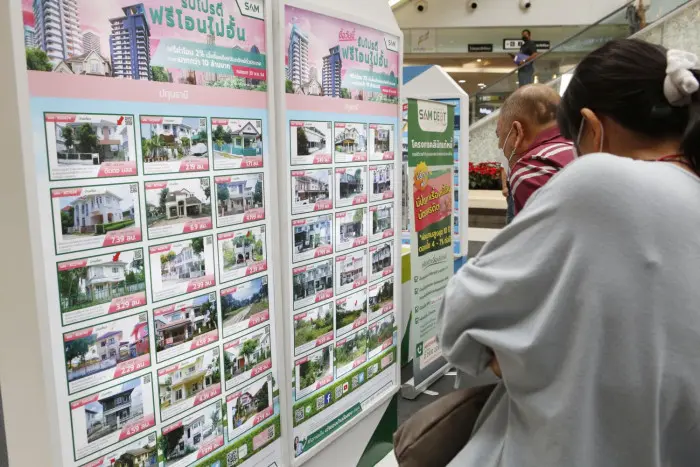
The growing supply of bank-owned distressed properties is adding to second-hand housing stock while making commercial banks more cautious about extending new home loans, according to the Real Estate Information Center (REIC).
Siddhipen Siddharthapong, acting assistant director-general of REIC, said second-hand homes originating from commercial banks' non-performing assets (NPAs) are one factor making lenders more cautious about extending mortgages to new customers.
"The development reflects concerns over borrowers' ability to service their existing mortgages, prompting banks to remain cautious about taking on additional housing loan risks," she said.
According to REIC, the number of second-hand homes offered for sale by commercial banks nationwide reached 13,432 units in the second quarter of 2026, up by 122.9% year-on-year.
Their combined asking value rose by 86.5% to 50.1 billion baht, making commercial banks the fastest-growing source of second-hand housing supply during the quarter.
The sharp increase came despite commercial banks accounting for only 6.9% of total accumulated second-hand homes listed for sale, compared with 36% for individuals and property agents.
The Legal Execution Department accounted for 31.5% of listed units, while specialised financial institutions represented 14% and asset management companies 11.7%.
According to REIC, commercial banks recorded the most significant growth among all seller groups, contributing to a change in the structure of the second-hand housing market.
By comparison, the number of homes listed by individuals and property agents increased by only 2.6% year-on-year, while listings by asset management companies rose by 4.8%.
The number of properties offered through the Legal Execution Department fell by 6.1%, making commercial banks the only major seller group with growth exceeding 100% during the quarter.
The increase in bank-owned properties also coincided with broader growth in the resale market. Total accumulated second-hand supply rose by 6.1% year-on-year to 195,941 units.
The combined value of listed second-hand homes increased by 24.9% to 941.2 billion baht, indicating that the market expanded more strongly in value than in unit terms.
SCB Economic Intelligence Center (SCB EIC) also reported a substantial supply of properties coming from financial institutions and other distressed sellers.
Second-hand homes listed for sale nationwide totalled around 196,000 units in the second quarter of 2026, down from a peak of 243,000 units in the first quarter.
However, properties listed by specialised financial institutions, commercial banks and asset management companies reached 63,753 units, the highest level in 10 quarters.
According to SCB EIC, household debt was also driving more second-hand homes from the Legal Execution Department onto the market, adding to existing supply.
Although bank-owned properties remain a relatively small share of total supply, their rapid expansion highlights growing pressure within the housing market, particularly as some homeowners struggle with debt-servicing costs.
The additional supply also comes as buyers increasingly turn to second-hand homes because of weak purchasing power and rising prices for newly built properties.
RESALE MARKET GAINS
The second-hand market showed stronger transaction growth in the second quarter, rising 24% year-on-year to 62,343 units nationwide.
Transfer value increased by 22.9% to 124.5 billion baht, according to REIC, indicating stronger demand for resale properties despite broader weakness in the housing market.
Greater Bangkok accounted for the largest share, with 26,388 second-hand homes transferred, representing 42.3% of the nationwide total.
Their combined transfer value reached 59 billion baht, accounting for 47.4% of the nationwide total, an increase of 29.4% year-on-year.
Condominiums recorded the strongest growth among property types, with transfers increasing by 39.4% year-on-year to 16,386 units. Their transfer value surged by 41% to 28.2 billion baht, while townhouses and detached houses also recorded double-digit growth during the quarter.
By price range, properties priced between 1.51–5 million baht recorded the strongest growth, increasing by an average of 25–30% year-on-year.
Properties priced at 2.01–3 million baht accounted for the largest share of transfer value, at 24%, highlighting continued demand for relatively affordable resale homes.
The stronger performance of lower-priced resale homes suggests buyers remain active where prices are within their financial reach, despite tighter mortgage conditions and concerns over household debt.
At the upper end, transfers of homes priced above 10 million baht declined by 1.3% in unit terms, although their combined value increased by 10.9%, reflecting higher average transaction values.
According to SCB EIC, second-hand homes are gaining popularity as buyers prioritise value for money, with their share of residential transfers in Bangkok and its surrounding provinces rising from 38% in 2019 to 56% in the first half of 2026.
It expects resale homes to maintain a larger share of transfers than newly built properties through the remainder of 2026 and into 2027, supported by lower prices and limited purchasing power.
CREDIT REMAINS KEY
According to SCB EIC, the growing appeal of second-hand homes reflects high household debt, slower income growth and stricter mortgage lending standards, which have made it harder for buyers to afford new properties.
Its 2026 survey found that more than 70% of prospective homebuyers planning to purchase within five years were interested in second-hand properties across all housing types.
Interest also increased across all price ranges, including homes priced above 10 million baht, suggesting the resale market is attracting higher-income buyers as well as middle- and lower-income households.
However, tighter mortgage standards could limit the ability of some prospective buyers to take advantage of lower-priced resale properties, creating a mismatch between affordability and access to financing.
For banks, the growing volume of distressed properties means they must manage existing problem assets while assessing the risks associated with new mortgage applications.
The trend could therefore affect both sides of banks' housing portfolios, as lenders seek to dispose of existing distressed assets while remaining cautious about extending new mortgages.
The issue is particularly relevant to the mass-market segment, where buyers depend heavily on mortgage financing and are more vulnerable to loan rejection or reduced borrowing capacity.
For developers, the growing role of second-hand homes provides another reason to focus on value for money and assess resale supply and competing prices before launching new projects.
SCB EIC also sees opportunities for online property platforms and agents to expand into one-stop services, while businesses that acquire, renovate and resell second-hand homes could benefit from growing interest in resale properties.
The trend could encourage developers to expand beyond traditional project development into property trading, renovation and related services, as the resale market becomes a more significant part of the housing industry.