



Billionaire Elon Musk has warned that the artificial intelligence industry could face a severe cash crunch in 2027 as technology companies race to build data centres and expand their computing capacity. The xAI chief executive said the challenge was not simply buying expensive chips and building facilities, but getting them operational quickly enough to start generating revenue.
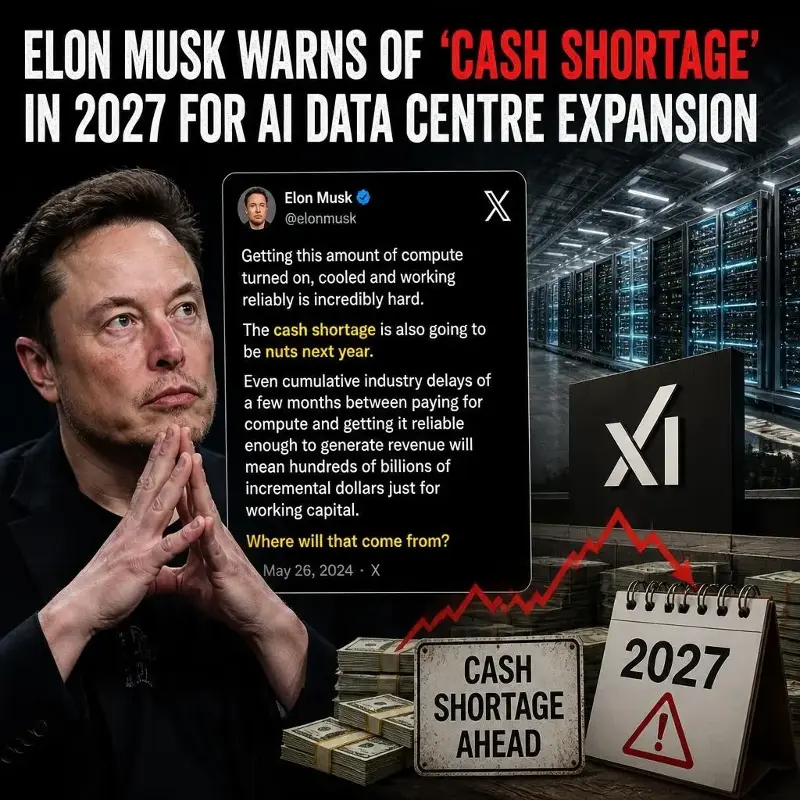
In a post on his social media platform X on Saturday, November 21, Elon Musk said that even a delay of a few months between paying for computing infrastructure and making it commercially operational could leave the industry needing hundreds of billions of dollars in additional working capital.
"Getting this amount of compute turned on, cooled and working reliably is incredibly hard.
"The cash shortage is also going to be nuts next year. Even cumulative industry delays of a few months between paying for compute and getting it reliable enough to generate revenue will mean hundreds of billions of incremental dollars just for working capital. Where will that come from?" Elon Musk wrote.
Why is Elon Musk worried about an AI cash shortage in 2027?
Elon Musk was responding to a post arguing that AI stocks remained undervalued despite rising costs of key components, including graphics processing units (GPUs), high-bandwidth memory (HBM) and dynamic random-access memory (DRAM).
The user also pointed to growing demand for AI research and model development, arguing that inference, the process of running trained AI models to generate responses, was becoming increasingly profitable.
Elon Musk, however, highlighted a problem with the economics of the AI boom. Companies must spend enormous sums on chips, servers, data centres, cooling systems and electricity before those facilities can reliably serve customers and generate income.
If construction, installation or testing takes longer than expected, companies have to keep funding their projects without receiving the revenue they had anticipated. That gap can create a substantial need for working capital, even when demand for computing services remains strong.
AI data centre spending crosses $500 billion as demand grows
The scale of the investment underway helps explain Musk's concerns.
According to research firm IDC, global spending on AI infrastructure reached $121.4 billion in the second quarter of 2026, marking a 53% increase from a year earlier. IDC has raised its full-year 2026 forecast to $521 billion.
The International Energy Agency (IEA) has also highlighted the pace of expansion. Capital expenditure by five major technology companies exceeded $400 billion in 2025 and is expected to rise by another 75% in 2026. The agency said the capacity of specialised AI data centres had more than tripled over the previous 18 months.
Power shortages and construction delays add to the pressure
Money is not the only obstacle facing the data centre industry. Securing electricity, connecting facilities to power grids and obtaining local approvals are becoming increasingly difficult.
A November 20 report by S&P Global said power shortages, delays in grid connections and opposition from local communities were complicating data centre expansion. US and Canadian net new data centre IT capacity is projected to rise to around 20 gigawatts in 2027, from approximately 8 gigawatts in 2026.
The IEA estimates that global data centre electricity consumption could nearly double from 485 terawatt-hours in 2025 to around 950 terawatt-hours by 2030.
Meanwhile, Reuters reported on November 17 that Intercontinental Exchange, the parent company of the New York Stock Exchange, had launched a tool to assess the risk of US data centre projects being delayed or halted. The tool considers factors including electricity and water costs, permitting records and local economic conditions.