



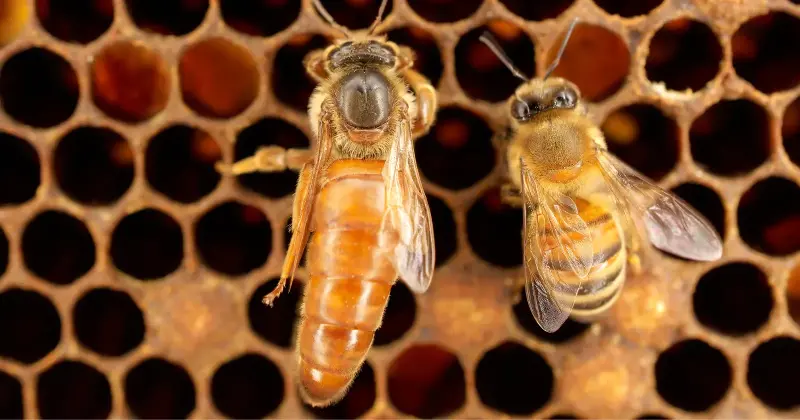
A queen honeybee can live for one or two years on average, and occasionally several years. A worker bee born in the same colony may survive for only a few weeks during summer.
That difference is remarkable because queens and workers are not separate types of bee with completely different sets of genes. Both develop from fertilised female eggs. What mainly sends them down different paths is how they are fed as larvae.
Scientists understand many of the biological processes involved, but they still cannot fully explain how such an early difference in diet produces such a large gap in lifespan.
A 2008 review summarised the contrast clearly: “Queen honeybees live for an average of one to two years, while workers live for about 15 to 38 days in summer and 150 to 200 days in winter”
The same starting point, two different lives
Young female honeybee larvae have the potential to become either queens or workers.
Larvae chosen to become queens receive a rich and plentiful supply of “royal jelly” throughout their development. Worker larvae are also fed glandular food at first, but their diet later changes in quantity and composition.
That feeding difference affects almost every part of the adult bee. A queen grows larger, develops functioning ovaries and becomes the colony’s main egg-layer. A worker remains mostly sterile and performs jobs such as cleaning, feeding larvae, guarding the hive and collecting food.
Researchers have spent decades trying to identify exactly what in the diet causes this transformation.
In a 2011 Nature paper, Masaki Kamakura proposed that a protein in royal jelly, known as royalactin, acted as the main trigger.
That explanation was later challenged. A subsequent Nature study found that royalactin alone was not enough to explain queen development.
The environment around the larva matters too. Researchers have found that both diet and the size of the cell in which the larva grows can influence whether it becomes a queen or a worker.
Even now, the full process remains unclear. As one research team wrote in PLOS Genetics, scientists still do not fully understand how different diets can change honeybee development so completely.
Why summer workers die so quickly
Worker lifespan depends heavily on the season and the job the bee performs.
Summer workers often live for only a few weeks because they carry out demanding and dangerous work. Foraging requires constant flight and exposes them to predators, bad weather, pesticides and accidents.
Workers that begin foraging earlier also tend to die sooner.
Winter workers can live for several months because they spend less time flying and are adapted to store more nutrients while keeping the colony alive through colder conditions.
This helps explain why summer and winter workers can have such different lifespans, even though both belong to the same caste.
What might keep queens alive
Scientists have identified several biological differences that may contribute to the queen’s longevity, although no single mechanism fully explains it.
One involves the fats that make up cell membranes. A 2007 study found that queen cell membranes were more resistant to a form of oxidative damage called lipid peroxidation.
The same study found that newly emerged workers initially had membrane profiles resembling those of queens, but became more vulnerable to lipid peroxidation during their first week of adult life. The researchers linked this change to the workers’ transition to a pollen-rich diet, which contains more polyunsaturated fats.
Other research points to differences in hormones, reproductive proteins and insulin-like signalling. Corona and colleagues studied the relationship among insulin-like signalling, juvenile hormone and vitellogenin, a protein best known for its role in egg production but also associated with antioxidant protection and longevity in honeybees.
They found that these systems interact differently in queens and workers. The researchers proposed that this unusual relationship may help queens combine high fertility with a long lifespan, although it does not provide a complete explanation.
Epigenetic regulation may also help determine whether a larva develops into a queen or a worker. Epigenetic changes do not rewrite the DNA sequence itself; instead, they can alter how genes are regulated and expressed.
In a 2008 study, researchers reduced the activity of an enzyme involved in DNA methylation and found that more larvae developed queen-like characteristics. The results suggested that nutrition can influence developmental fate partly by changing how genetic information is used.
Those do not prove that royal jelly alone produces the queen’s long life. They do, however, provide evidence that nutrition can influence honeybee survival even after larval development has ended.
Why scientists still do not have a complete answer
Part of the queen’s advantage is easy to understand. She remains protected inside the hive and does not face the dangers of daily foraging.
But a lighter workload cannot explain everything. A queen is not biologically inactive. At her peak, she can lay 1,500 to 2,000 eggs a day, producing close to her own body weight in eggs. In many animals, heavy reproduction is linked to a shorter life. Honeybee queens appear to combine very high fertility with unusually long survival.
Scientists now know many of the pieces involved in honeybee ageing: diet, hormones, metabolism, insulin-like signalling, cell membranes, reproductive proteins and epigenetic changes.
What they still lack is a complete explanation showing how all those pieces fit together.