



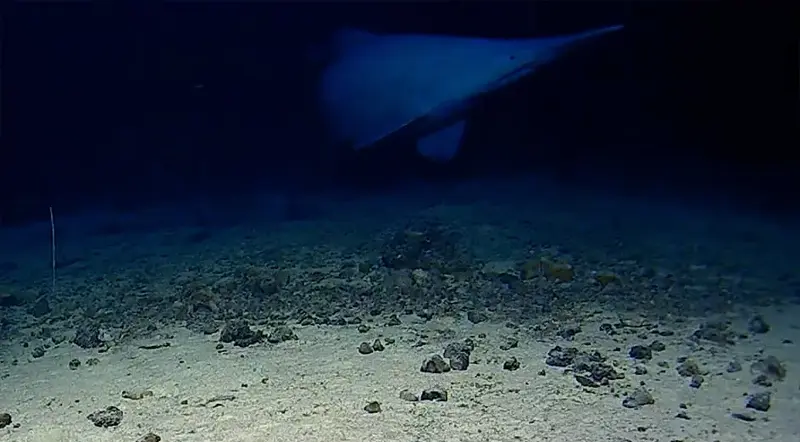
For more than 50 days, cameras watched the deep Pacific. Then, at 1,997 metres on the slope of the Tonga Trench, a goblin shark entered the frame and was gone a little more than 20 seconds later.
The encounter was extraordinarily brief, but it helped produce the first peer-reviewed observations of a living goblin shark in its natural deep-ocean habitat. It also pushed the species’ confirmed depth and geographic ranges far beyond the places where specimens had previously been collected.
One detail in the story needs careful wording. The modern goblin shark species has not been shown to have existed unchanged for 125 million years. Rather, it is the sole living representative of a shark family whose lineage reaches back nearly that far.
The camera waited far longer than the shark stayed
The Tonga Trench footage was recorded in August 2024 during the Inkfish Open Ocean Expedition aboard the research vessel Dagon. A baited camera mounted on a weighted seafloor platform, known as a lander, captured the shark swimming above the bottom on the trench’s northern slope.
The expedition accumulated more than 50 days of continuous footage across deployments spanning depths from 800 to 10,800 metres. According to the University of Western Australia, the goblin shark occupied just over 20 seconds of that immense record.
The animal was probably female. It passed the camera with its jaws retracted and its long, flattened snout extending ahead of its head, looking markedly different from the distorted specimens commonly photographed after being hauled from deep water.
A second discovery had been sitting in an archive
The Tonga observation was not the study’s only breakthrough. Researchers also identified footage recorded in July 2019 near an unnamed seamount northwest of Jarvis Island in the central Pacific. The remotely operated vehicle Hercules filmed a male goblin shark at 1,237 metres during an Ocean Exploration Trust expedition.
The animal was not immediately recognised. University of Hawaii researcher Aaron Judah identified it years later while reviewing archived video. Nautilus Live’s account of the rediscovery describes how a finding can remain hidden even after a camera has captured it.
The two records were published together on 19 May 2026 in the Journal of Fish Biology. The authors describe them as the first confirmed live, in-situ observations of Mitsukurina owstoni. Earlier goblin sharks had been seen alive after capture, but not documented healthy and free-swimming in their ordinary deep habitat.
The 125-million-year figure belongs to a lineage
Goblin sharks are often called living fossils because Mitsukurina owstoni is the only surviving species in the family Mitsukurinidae. Fossil members of that lineage reach back nearly 125 million years. The living species itself was scientifically described in 1898, so saying this individual ended 125 million years without an observation would overstate what the evidence shows.
Its unusual anatomy reflects life in dark water. The blade-like snout contains sensory organs that can detect weak electrical fields produced by prey. When the shark strikes, its jaws can shoot forward with exceptional speed. A high-speed analysis of recorded feeding behaviour found that the jaw projection was proportionally greater than in any other shark then measured, inspiring the description “slingshot feeding.”
In the Tonga footage, however, the mouth remained in its normal retracted position. That matters because familiar photographs of dead specimens often show the jaws thrust forward, exaggerating the shark’s already unusual appearance.
The depth record changed two maps at once
Before the Tonga observation, published records generally placed goblin sharks no deeper than about 1,300 metres. The new sighting extended the species’ confirmed depth by roughly 700 metres. It also extended the known depth range of Lamniformes, the shark order that includes makos, threshers and great whites, by 108 metres.
Both observations also occurred in central Pacific locations outside the narrow areas represented by earlier specimen records. Goblin sharks have been collected from widely separated parts of the Atlantic, Indian and Pacific oceans, suggesting a broad distribution, but the record is sparse and heavily shaped by accidental fisheries catches.
The new locations therefore do more than add points to a map. They allow the species to be included more confidently in regional biodiversity assessments and management planning where its presence had not been confirmed.
Twenty seconds reveal how much remains unseen
The recordings do not show how many goblin sharks live in the central Pacific, how often they use trench slopes and seamounts, what they eat there or where they reproduce. Even their conservation status rests on limited information. An Australian species assessment lists the goblin shark as Least Concern, while noting substantial uncertainty about population trends, life history and connectivity.
That is why the researchers call for more remote video sampling. Cameras can observe deep animals without hooking them, dragging them through enormous pressure changes or mistaking the trauma of capture for natural behaviour.
More than 50 days of footage yielded a glimpse lasting only seconds. Another important observation waited unnoticed in an archive for years. Together, those facts say as much about the limits of deep-sea exploration as they do about the goblin shark: absence from the record may simply mean that nobody has looked long enough, or closely enough, to see what was there.
The post Scientists recorded more than 50 days of deep-ocean footage before a goblin shark appeared for just over 20 seconds near the Tonga Trench, one of the first two confirmed sightings of this 125-million-year lineage alive in its natural habitat appeared first on Space Daily.