



In 1962, Washington Dulles International Airport debuted a radical new feature which aimed to redefine the air travel experience: the mobile lounge.
Eero Saarinen, a Finnish-American architect, had taken note of the increasingly unmanageable distances passengers were being forced to walk through airports, and decided he would bring the terminal directly to the plane instead.
Sadly, his innovative “lounge on wheels” concept did not take off – as is evident from the fact that we still trudge for what often seems an interminable length of time to get to our gate, overpriced drink in hand, rather than being ferried there, sedentary.
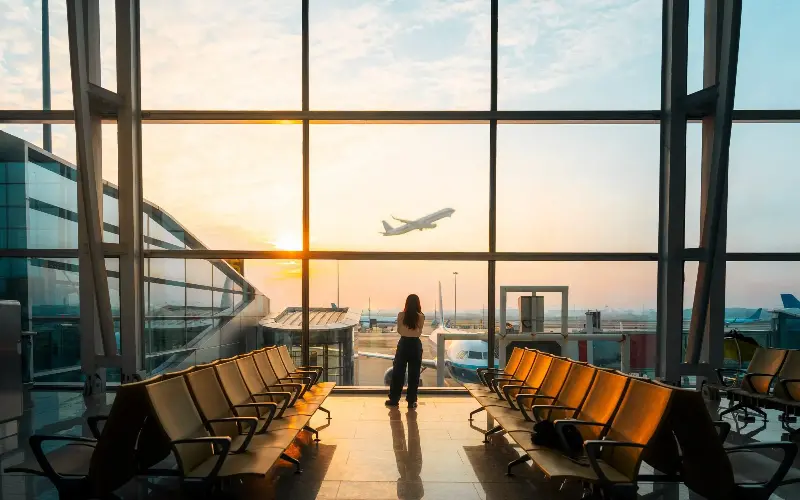
You might think this is all down to ageing infrastructure, but you’d be wrong. It is entirely by design. Airport departure lounges today are not geared towards comfort, but towards creating a carefully calibrated environment that impacts passengers’ mood, movement and spending.
Once you’re in the know about these design secrets, you’ll find it hard not to notice them.
It starts at check-in
At most airports, the dreaded long wait at the check-in desk is largely over. Online check-in means travellers with only carry-on bags can head straight to security, while self-service systems have made dropping off hold luggage much speedier.
It’s convenient for passengers, but it’s beneficial to the airport, too. Have you noticed how, despite this phase of the journey being quicker than ever, the guidelines on how early to get to the airport before your flight have barely changed?
The less time passengers spend queuing to check in, the longer they will be in the lounge; a period known as the “golden hour”. Similar thinking is behind the infuriatingly last minute gate announcements.
The ‘recomposure zone’
Going through security is a faff at best and acutely stressful at worst. Passengers tend to feel a sense of relief after making it through this obstacle course of ever-changing liquid rules in various states of undress.
This is partially down to… architecture. Psychologists have noted that people feel calmer in spaces with high ceilings and plenty of light, so airport designers ensure this is provided the moment you step into the lounge. They call this the “recomposure zone”, and it’s not solely created for passengers’ wellbeing.
Ibrahim Ibrahim, a managing director of Portland Design, a commercial design consultancy that counts Heathrow Airport among its clients, says: “People gravitate towards somewhere which is either naturally illuminated or has high illumination.
“When a passenger gets there and feels relaxed and decompressed, that’s the point of maximum engagement with brands.”
Skewed walkways
The winding route through duty-free that snakes between perfumes and whiskies is not an aesthetic design choice. It usually curves to the left to – you guessed it – encourage you to splash your cash.
According to a report by aviation consultants at Intervistas, the fact that the majority of people are right-handed and pull their suitcase with their dominant hand forces them to veer left whilst walking to maintain balance.
As a result, most passengers will look right while unconsciously walking left. Walkways both within duty-free and the departure lounge are therefore often curved, with more merchandise placed to the right at the apexes of bends.
Why the seats are uncomfortable
Another hallmark of the airport which has human behavioural science at its core is the back-breakingly uncomfortable seating.
You would think that, in a place where hundreds of people are corralled into a large waiting area, seating would be a designer’s priority. Instead, we are presented with rows of stiff chairs – especially tricky to make use of if you’re travelling in a group.
Several years ago, designers at Heathrow Airport set about changing this sad state of affairs with “hub” seating; four comfy chairs clustered around a coffee table. But what they found was that as soon as one person occupied a cluster, everyone else avoided it.
Barry Weekes, then the head of Design at the airport told The Telegraph: “It became a territorial thing. The more standard set up prevents people creating their own little fiefdom.”
A liminal space
Much discussion has raged about the British tradition of the airport pint.
For many of us, it’s simply a beloved pre-holiday ritual – but to airport designers, it’s an indicator of how our thinking changes when we step into the liminal realm of the departure lounge.
“Your passenger is in a state of excitement and therefore does things they would never do on a high street or in a shopping centre,” says Ibrahim. “Normally, they would not drink a pint of Guinness at 7 o’clock in the morning.”
Creating an environment which caters to impulsive, and sometimes extravagant choices is therefore crucial. Presumably, this explains the bizarre presence in most lounges of an incredibly out-of-place champagne and oyster bar.
Wayfinding
Rory Sutherland, an advertising executive and author, says: “Airport signage is often atrocious. There is no allowance made for a small mistake, and arrows are ambiguous. Miss one sign to your lounge and you can walk 500 yards in the wrong direction.”
There is, however, a reason for this perceived lack of prominence when it comes to signage. To guide passengers through lounges and corridors, airports primarily use wayfinding; a subtle combination of lighting, clear sightlines and floor patterns which aims to help people intuitively know where to go.
Signs play an important role. Frutiger (which was designed for Paris’s Charles De Gaulle Airport in 1968) and Helvetica are the most commonly used fonts, with their open letter shapes considered to be the most easily decipherable.
What does the future hold?
Such design “hacks” have led to departure lounges becoming almost identical regardless of where you are in the world, and many would welcome a change to these cookie-cutter spaces.
Ibrahim believes that the airport lounge will follow in the footsteps of the high street and see more wellness experiences appearing alongside retail and food. Passengers could attend yoga classes, have massages, perhaps even get a haircut.
There might also be a departure from the Toblerone-heavy shopping options as more airports opt to stock local brands. And he is still determined to crack the better-chairs conundrum.
So the days of doing a yoga class and having a massage before your flight might not be too far away. But for now, weird walking, unnecessary bubbly and a mad dash to the gate will have to do.