



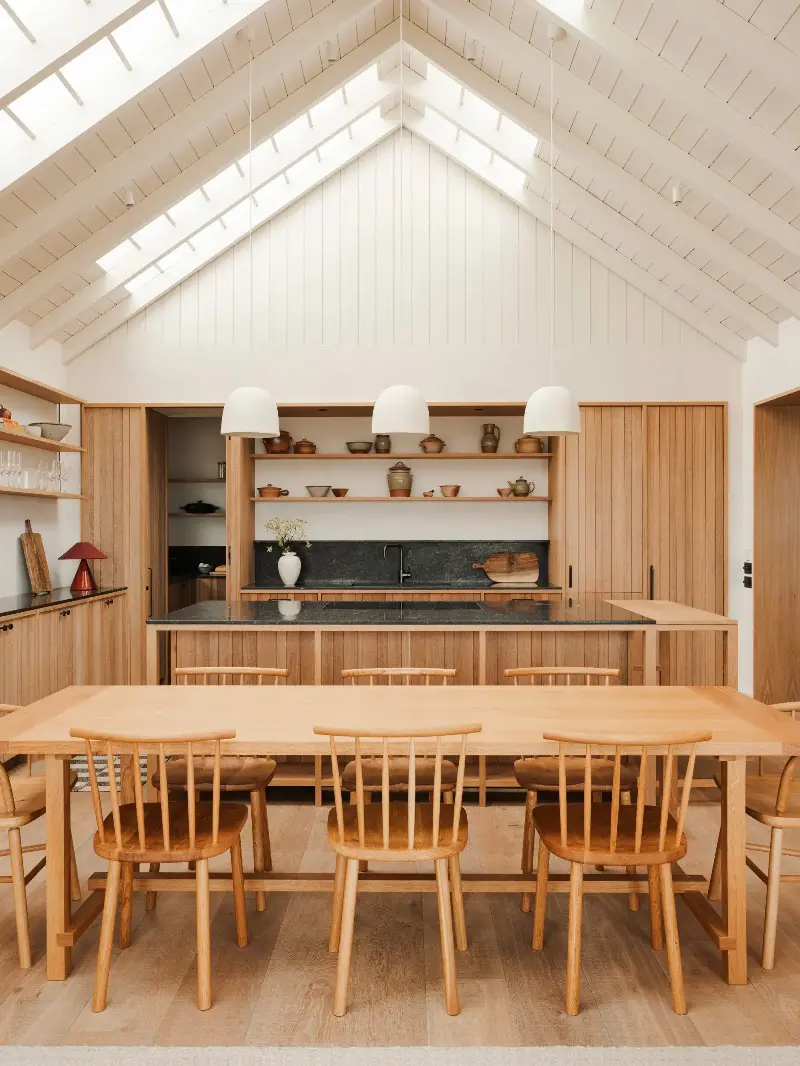
If the words “wooden kitchen” immediately make you think of orange-tinged pine cupboards and cathedral-style doors, you are not alone. For years, natural wood kitchens have been deemed so deeply unfashionable, they have had design enthusiasts reaching for painted cabinets instead.
But it is time to put down those colour charts. Interior designers are seeing the trend of the “naked” kitchen, which celebrates wood in its purest form. However this new generation of timber kitchens has moved on considerably from its drab past. Instead, think beautifully pared-back units, clean architectural lines and stylish hardware.
For Craig Ross and Hilly Murrell, the founders of London-based Fell Studio, which they set up five years ago, the resurgence is of little surprise. The duo have only ever designed kitchens in solid wood, building the practice around a belief that the material itself should be celebrated and not concealed under layers of paint.
“We almost started the business as a rebuttal to the painted kitchen world,” Ross says. “Even expensive painted kitchens are often made from fairly basic sheet materials hidden behind paint. For us, it’s about having a genuine connection to the material itself. There’s a lot of emerging studies, mostly out of Scandinavia, that just being around wooden finishes genuinely improves your wellbeing.”
Why wooden kitchens are popular again
The duo believe that there are a number of reasons behind the popularity of the new-look wooden kitchen. “It’s more practical and more durable, which most people are generally concerned about. It is something they use every day, so they want it to be robust and go through the trials of life with them,” notes Murrell. “Painted kitchens are at their best on day one. After that, they’re on a bit of a downhill journey. Wooden kitchens get better with age. We are now seeing more family households choosing natural wood who perhaps had a white painted kitchen 20 years ago.”
And quality is also a major factor. “Because we’re using solid wood doors, our kitchens can be refinished forever, in theory. If they get dented, you know it’s the same material underneath, and you’re not going to reveal chipboard hiding behind.” That longevity is becoming increasingly attractive as homeowners think more carefully about buying once rather than replacing repeatedly.
Carolina Maluhy, an architect and interior designer, has also seen an increase in requests for wooden kitchens. “Wood carries a timeless quality that continues to be highly valued by clients and one that I seek to incorporate into our projects whenever possible,” she says. “Natural materials contribute to creating spaces that feel warmer, more authentic and enduring.”
Equally, London-based architectural and interior design studio De Rosee Sa has been incorporating more wooden kitchens into their high-end homes. “We’re always drawn to timber kitchens because they bring a warmth and tactility that’s difficult to replicate with any other material,” says senior project architect George Yallop. “The kitchen is the most heavily used room in the home, so it makes sense for it to feel natural, comfortable and made to be lived in.”
He also points to wood’s versatility. “Whether the architecture is contemporary or more traditional, it can be detailed to suit the character of the house, making it one of the few materials that feels both timeless and entirely adaptable,” he says.
In a recent Cornwall project, De Rosee Sa chose an oak with a saw-mark finish to give the cabinetry a more rustic look. “Rather than feeling pristine, it has a sense of already belonging to the house – somewhere a family can cook together without worrying about every knock or scratch,” adds Yallop.
How to choose a modern wooden kitchen
While wooden kitchens of past revelled in decorative mouldings and heavily varnished knotty pine, today’s versions play by different rules. “Simplicity is one of the key factors in a kitchen’s longevity, allowing the materials to speak for themselves,” says Maluhy. “An excess of detailing or decorative elements can date a project.”
Fell Studio agrees that flat-front or lightly detailed cabinet doors have largely replaced elaborate designs. “A big difference in aesthetics is that a lot of those kitchens in the Eighties were Shaker style with big, wide profiling,” explains Ross. “Primarily our design and making approach is we try to minimise the number of processes, which means there aren’t really decorative touches that don’t have a practical functionality.”
The actual timber selected is another consideration. Fell Studio typically works with European oak, ash and beech, which are all chosen for their durability and quieter grain. “Not all timber is equal,” says Ross. “If you are removing decorative detailing, the timber itself has to be exceptional.”
But you don’t have to commit to simply one wood tone, according to Richard Moore, creative director at luxury kitchen company Martin Moore. One of its kitchens featured in the decorative showcase event WOW!house last month incorporated fumed oak in three bespoke colours – alabaster, umbra and mocha – to both cabinet exteriors and interiors. “Rich tonal variations to add depth and visual interest,” says Moore.
The right finish makes all the difference
Achieving a modern look also depends on what you mix the wood with. Pairing oak cabinetry with stainless steel worktops will give a sleek, contemporary look while introducing marble or limestone can give a more luxurious feel.
“Natural stone works beautifully with wooden kitchens,” says Maluhy. “Engineered quartz and high-performance porcelain surfaces have evolved in recent years, offering remarkably faithful interpretations of natural marble, with realistic veining and sophisticated patterns.”
Understated hardware keeps the overall look fresh. Slim nickel pulls (a warmer alternative to stainless steel), blackened steel or unlacquered brass all complement natural timber without competing with it.
Other ways to get the look
Fortunately you don’t have to replace perfectly good cabinetry to tap into the look, assures Carina Raymond, an interior designer and founder of Studio Raymond.
“A solid wood island, open shelving, dining table or breakfast bar can add warmth and contrast, while smaller details such as chopping boards, stools and decorative accessories help to introduce natural texture,” she says. “I often find that layering wood throughout a kitchen creates a more inviting and balanced space, particularly when paired with natural stone, aged brass and richly textured fabrics.”
Sophie Pringle of Surrey-based interior design studio Pringle & Pringle agrees. “Timber can be introduced in countless ways. We particularly love using it in areas that are experienced in a more tactile way, such as pantry interiors, breakfast stations and island worktops where its warmth and natural texture can be appreciated. In our own pantry designs, we often leave the interiors a natural timber, celebrating the beauty of the material.”
One substantial timber piece can immediately warm a painted kitchen. Interior designer Laura Stephens, for instance, created a bespoke oak island for her London kitchen. “It was designed to have a timeless, almost free-standing quality, bringing warmth and contrast to the lighter elements,” she explains. “I love using wood because it helps to soften the harder surfaces often found in kitchens, such as stone, tiles and cabinetry.”
So is this a look set to stay the course? Carina Raymond believes so. “Unlike many kitchen trends that come and go, wood feels timeless and inherently connected to the way we want our homes to feel,” she says. “Wood introduces texture, depth and a natural softness that painted or man-made finishes often cannot replicate.”