



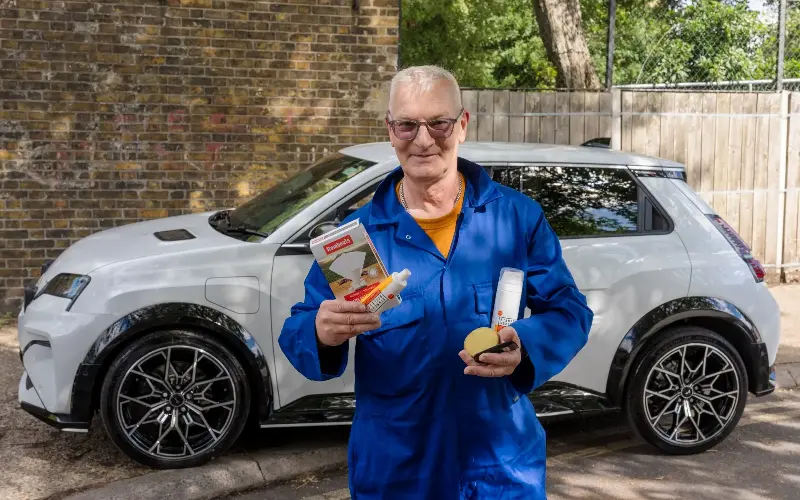
Technology in cars has helped us in countless ways. Reversing cameras ensure that bumps and scrapes while manoeuvring in tight spaces are a thing of the past, while high-definition screens display detailed maps so that we can navigate with ease.
Yet every innovation seems to generate a new annoyance; water and dirt accumulate on the camera, screens (especially the plethora of touchscreens) get dusty and smudge easily, while plastic light covers become opaque with age.
Fortunately, there are some decidedly low-tech – and cheap – solutions. The hacks featured here rely on age-old chemical treatments or simple ingenuity to resolve tech troubles.
1. Clean interior screens
Modern cars have screens everywhere, including rear-seat passengers in some family models, enabling children to play games or watch films during long road trips.
How do you keep the screens clean? Some of us have tried paper towels, but their composition uses abrasive particles designed to soak up water. A better solution is to use coffee filters, of the type that you may already use in a drip coffee-maker. “They are tightly-woven, low-lint and chemically simple – meaning no contaminants in your coffee – without the added material,” says Prof Paul Roach, from Loughborough University in Leicestershire.
Oh, and make sure that the filter is unused. Used ones will contain contaminants – and are likely to be a soggy mess.
2. Prevent fog build-up on the inside of your windscreen
Does this ever happen to you? During winter or on a muggy day, your windscreen fogs over and you have to blast the defrost, which takes time to work its magic. A better solution is to wipe shaving cream or even a bar of soap over the inside of the screen, according to Nicholas Huff, a research and development manager at the adhesive and sealant firm Sunstar Engineering.
“Soap and shaving cream contain surfactants, which are molecules that can both attract and repel water,” he says. “When a very thin surfactant residue remains on glass, it lowers the surface tension of condensed water. Instead of forming many separate microscopic droplets that scatter light, the moisture can spread into a more uniform film that’s easier to see through.”
Note that an aerosol foam is required, rather than one of the newer shaving gels.
3. Restore clarity to reversing cameras
It happens during every rainstorm: your reversing camera becomes useless due to water droplets accumulating on the lens. Instead of pulling over and wiping the rounded camera lens repeatedly, there’s a smarter solution. Adding a light coating of baby oil or rubbing a potato on the camera works wonders. It’s all due to a simple chemical explanation.
Prof Roach explained that oil acts as an inhibitor – basically, the water forms into large droplets and rolls off. Potato skins contain starch that performs much the same function. “Starch allows water to spread more evenly into a film across the surface rather than forming into little tiny droplets,” he says.
A potato tends to be less messy – and also makes chips, which baby oil can’t.
4. Remove haze from plastic light lenses
This hack is good enough for professional car detailing experts so it will work for you. On older cars, the headlights or rear lights often become yellowed over time. Matt Clamp, an automotive specialist at Scrap Car Comparison, says many drivers don’t realise that the degradation is caused by sunlight. He says using toothpaste is a common fix, even if you have to repeat the process every so often. It must be white toothpaste though, so forget the minty-fresh stripes.
From a chemical point of view, the polishing agent we use for our teeth works just as well to remove residue from the plastic covers of car lights – and it’s a cheap alternative to expensive polishers.
“The headlights are usually made from polycarbonate, which oxidises over time to create a thin roughened and yellow surface, which cracks and scatters light, making it appear cloudy,” says Prof Roach. “The toothpaste acts as a mild abrasive, creating a polishing effect and removing the outer fractured layer of plastic on the headlight.”
One word of caution, though: toothpaste can also remove whatever is left of the UV protection, so while the lights might look brighter, you may need to clean them more often.
5. Unlock the doors without using remote central locking
You approach your car, press the key fob button to unlock the doors. Nothing happens. The unit has malfunctioned or, most probably, the battery has died.
Before panicking, a simple solution could well be at hand; your electronic key fob might contain a hidden metal key that you can remove and unlock the car manually. It’s still quite common, even in the latest cars, says Clamp, as evidenced by our Alpine A290 GT test car.
He says many drivers are surprised when he shows them how to remove the key, but the relentless march of technology could soon render a hidden physical key superfluous. “Some of the very newest cars are starting to use digital keys or phone access instead,” he notes.
Yet more electronic trickery that makes our lives easier – until it goes wrong, that is.
Let us know your car care tips and tricks in the comments section below.