


The hypothesis, published on September 14th in The Astrophysical Journal by scientists at the University of California, Riverside (USA), calls this a case of "cannibalism" among celestial bodies. The research offers a new explanation for why Venus, the second planet from the sun and similar in size, mass, and structure to Earth, lacks natural satellites.
"If Venus ever had a moon, it's highly likely the planet couldn't have kept it," lead author Stephen Krane told Reuters. "That moon would have eventually fallen off within a relatively short period of time."
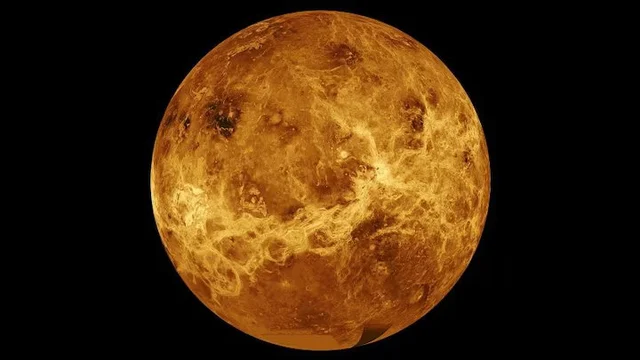
Data from NASA's Magellan spacecraft and Pioneer Venus orbiter reveals the planet Venus.
Photo: REUTERS
Research suggests that the planet's rotation speed plays a crucial role in determining the moon's fate. Venus takes approximately 243 Earth days to complete one rotation around its axis, while Earth takes only 24 hours—about 200 times faster than Venus.
In addition, the research also focuses on the dynamics of the Earth-Moon system to clarify the influence of rotation speed on the satellite's orbit. On Earth, energy from rotation is transferred to the Moon, causing the satellite to gradually move away from Earth at a rate of about 4 cm per year. Scientists measured this distance using reflective mirrors placed on the lunar surface by Apollo 11 astronauts in 1969.
Meanwhile, Venus's extremely slow rotation could cause the satellite to move in the opposite direction, getting closer and closer to the planet. Eventually, the satellite could fall onto the surface of Venus. This mechanism is considered a new explanation for why the planet currently has no natural satellites.
Krane said that computer models based on planetary physics and simulations of gravitational interaction between Venus and hypothetical moons of varying sizes all yielded similar results. Accordingly, Venus's extremely slow rotation speed would cause any natural satellite that ever orbited the planet to gradually become unstable, spiral closer to Venus, and eventually be swallowed up in a catastrophic collision.
This event may have occurred within the first billion years after Venus formed, about 4.5 billion years ago, when the solar system was still in its early stages.
Previously, scientists have also suggested the possibility that Venus may never have had a satellite, or that its satellites may have been destroyed in a collision.
Although there is no evidence to suggest that Venus ever had a moon, Krane believes this possibility is worth considering. According to him, in the early stages of the solar system, large rocky objects constantly collided with planets, and Venus may have experienced more collisions than Earth due to its closer proximity to the sun.
Scientists also expect that NASA's DAVINCI+ and VERITAS missions, scheduled for launch in the late 2020s or early 2030s, will help to learn more about Venus's atmosphere and geology.
Venus is similar in size and rocky structure to Earth but possesses a dense, toxic atmosphere and an extremely strong greenhouse effect. The planet's surface temperature can reach 471 degrees Celsius, hot enough to melt lead.